
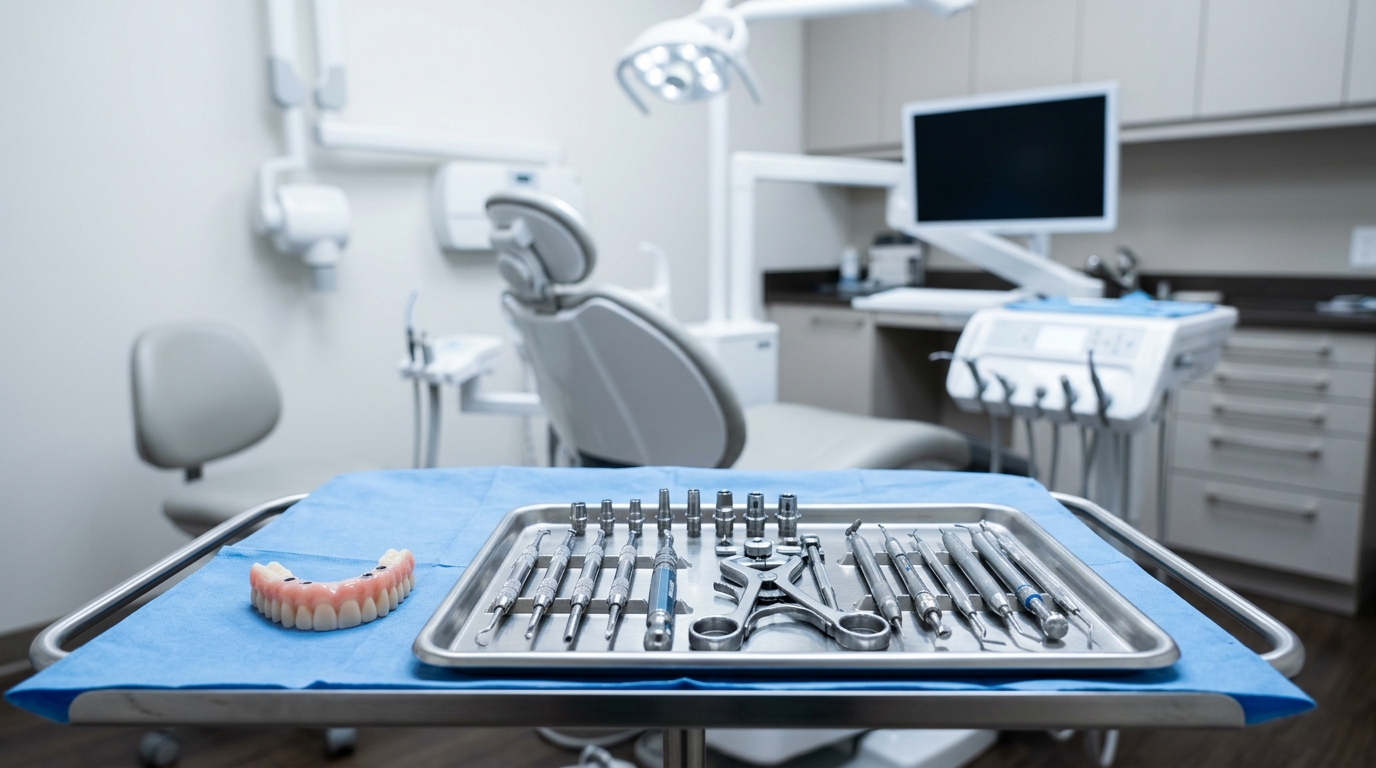
Full-arch implant treatment is the most profitable and the most punishing procedure a busy office runs. When the choreography is dialed in, a same-day conversion feels almost routine. When it isn’t, the case bleeds chair time, your surgical assistant is improvising, and the lab is reworking a prosthesis that should have fit the first time. The difference between those two outcomes is rarely surgical talent. It is workflow. This article walks through the sequencing, team roles, and conversion mechanics that let you scale a full-arch program while holding predictability constant.
Predictability Is an Operational Property, Not Just a Clinical One
We tend to frame predictability around primary stability, bone quality, and implant positioning—and those matter. But in a high-volume setting, most of the variance that reaches the patient is operational: a missing component, a verification step skipped under time pressure, an unclear handoff between surgeon and restorative provider. A predictable full-arch program treats the day as a system with defined inputs, checkpoints, and owners. The clinical decisions stay in your hands; the logistics should run on rails.
The practical test is simple. If your most experienced surgical assistant is out, does the case still run smoothly? If the answer is no, your predictability lives in one person’s head rather than in your process. That is the first bottleneck to solve.
Sequence the Day Backward From the Conversion
The most common scheduling error is planning forward from incision. Instead, anchor the day to the prosthetic conversion and work backward. The conversion—picking up the multi-unit abutment copings into the interim prosthesis—is the rate-limiting step, and it cannot start until extractions, alveoloplasty, implant placement, and abutment selection are all complete and verified.
A clean sequence for a single-arch case typically runs:
- Pre-surgical verification — confirm the surgical guide (if used), the interim prosthesis, and the full component inventory are physically on the tray before the patient is seated.
- Atraumatic extraction and site debridement — preserve buccal plate, remove all granulation tissue, and establish a clean field.
- Alveoloplasty to the restorative platform — create the prosthetic space you actually need; under-reduction here is the single most frequent cause of a bulky, weak conversion.
- Osteotomy and implant placement — sequence posterior to anterior or per your guided protocol, confirming insertion torque as you go.
- Multi-unit abutment selection and seating — choose angulation and cuff height deliberately; this is where the prosthetic path is set.
- Conversion — only once everything above is locked.
Mapping this backward tells you exactly when each team member needs to be staged and when the lab tech or conversion specialist must be chairside—not paged for, but already present.
Define Roles So No One Is Improvising
Full-arch surgery is a three- to four-person procedure, and ambiguity about who owns what is where minutes disappear. A workable division of labor:
- Surgeon — extractions, bone reduction, osteotomy, placement, abutment torque, and final clinical sign-off. Nothing else should compete for the surgeon’s attention during the surgical phase.
- Surgical assistant — owns the sterile field, instrument flow, irrigation, and component anticipation. This person should be handing you the next item before you ask.
- Circulating assistant — owns inventory, retrieves components, manages suction changeover, and bridges to the front desk and lab. This is the role most offices skip and most need.
- Conversion provider — the restorative dentist or a trained lab technician who takes over the prosthesis the moment abutments are seated. Overlapping the conversion with final suturing is how you reclaim 30 to 45 minutes.
Write these roles down. Run a 10-minute morning huddle for every full-arch day that names who fills each seat and walks the sequence aloud. It feels redundant until the day it prevents a 20-minute scramble for a driver that was never opened.
Prosthetic Conversion: Where Programs Live or Die
The conversion is the step that most separates a smooth program from a chaotic one, because it depends on decisions made an hour earlier. A few principles keep it predictable:
Earn your prosthetic space. Most conversion struggles trace back to inadequate restorative space. You generally want to confirm sufficient interarch clearance for the material and connection you’ve chosen before you commit to placement depth. Verify it with a measurement, not a glance.
Manage abutment angulation deliberately. Angled multi-unit abutments exist to correct divergence and bring screw access lingual or occlusal. Choosing them proactively—rather than discovering divergence at the prosthetic stage—saves the conversion from becoming an exercise in damage control.
Block out aggressively and seal completely. Acrylic locking into an undercut or flowing into the access channel is the classic conversion disaster. Disciplined block-out around each coping protects both the prosthesis and your timeline.
Verify passive fit before the patient leaves. A single-screw test and a tactile check for rock confirm the framework seats without strain. Two minutes here prevents a screw-loosening callback next week.
Attacking the Operational Bottlenecks
Once sequencing and roles are solid, the remaining drag is logistical. The recurring offenders in busy offices:
- Component readiness. Build a standardized full-arch tray and a printed pull-list checklist confirmed the day before. The cost of one missing angled abutment mid-surgery dwarfs the cost of over-preparing.
- Lab coordination. Whether you convert in-house or with a chairside technician, the prosthetic plan, shade, and tooth position should be settled before surgical day—never negotiated while the patient is open.
- Room turnover. Full-arch days collapse when a single operatory is doing surgery, conversion, and recovery in series. Stagger across two rooms so the surgeon moves while the conversion finishes.
- Documentation drag. Capture torque values, component lot numbers, and abutment selections in real time on a structured form rather than reconstructing them after the patient leaves. It protects you medico-legally and feeds your recall workflow.
Build the Program, Then Scale It
The offices that run four or five full-arch cases a week without quality drift are not faster surgeons—they are better organized. They have turned a heroic procedure into a repeatable one by defining the sequence, assigning the roles, controlling the conversion, and engineering out the logistical friction. Start by documenting your current workflow honestly, identify the one bottleneck that costs you the most time, and fix it before adding volume. Predictability scales when the system does the remembering, freeing you to do the dentistry.